

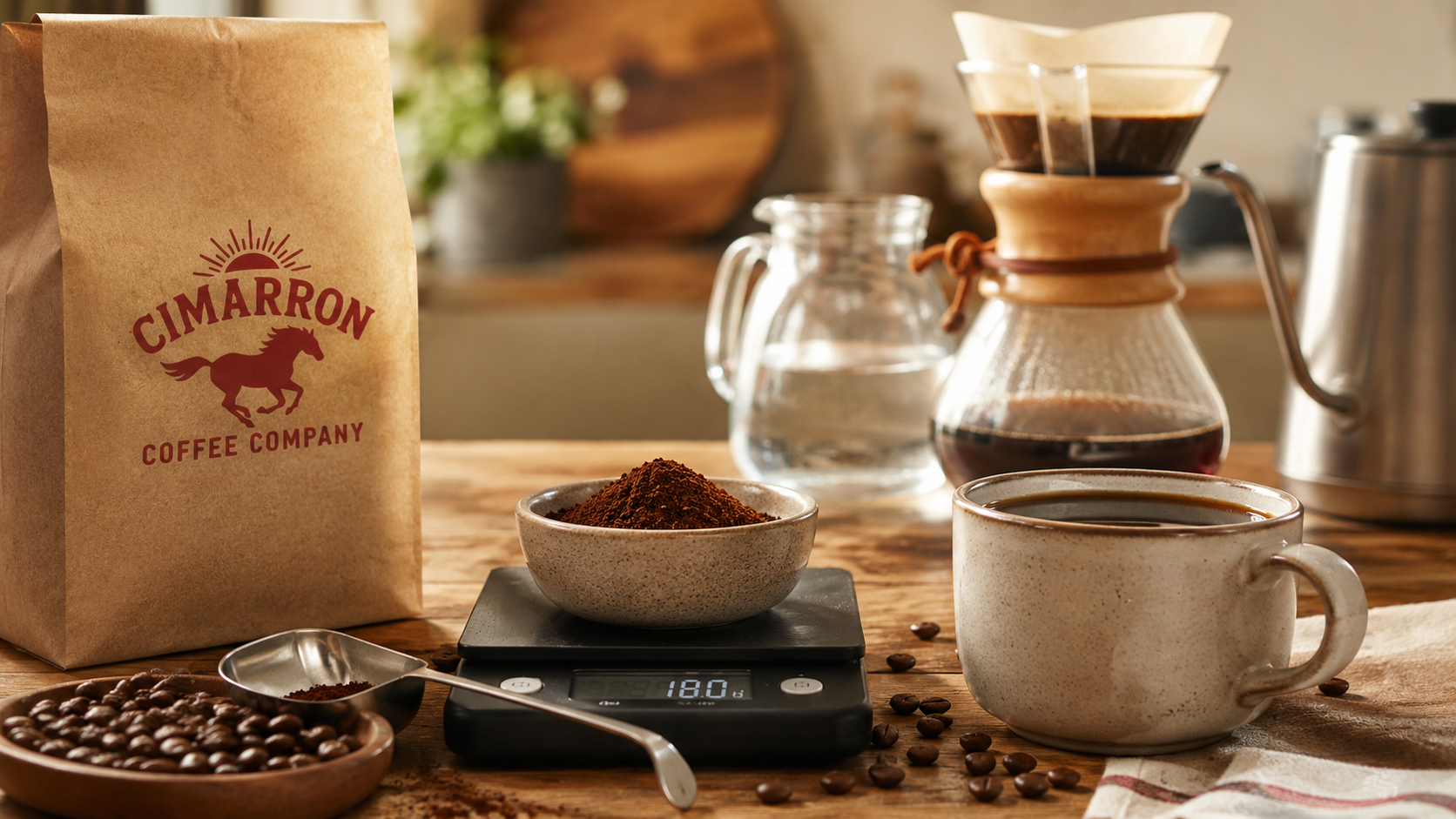
A better cup starts with a repeatable recipe
If your coffee tastes great one morning and disappointing the next, the beans may not be the problem. The amount of coffee and water can change more than people realize when both are measured by eye.
A consistent ratio gives you a dependable starting point. Once the cup is repeatable, making it stronger or lighter becomes a simple adjustment instead of guesswork.
A useful starting ratio is 1:16
A common starting point is about one part coffee to sixteen parts water by weight. That means 20 grams of coffee would pair with about 320 grams of water. For a larger batch, 60 grams of coffee works with roughly 960 grams of water.
You do not have to treat 1:16 as a law. Think of it as a baseline. If you prefer a stronger cup, use a little more coffee. If you prefer a lighter cup, use a little less.
What if you do not own a scale?
A small kitchen scale is the easiest way to stay consistent, but you can still improve your coffee without one. Use the same scoop or measuring spoon every day and fill it the same way. Then measure the water to a consistent mark on your brewer.
The exact volume of a scoop varies with grind and bean density, so tablespoon measurements are less precise than weight. Consistency is still valuable. Once you find a combination you like, write it down.
Your coffee maker cup may not be a real cup
One common source of confusion is the numbering on automatic coffee makers. A brewer labeled for 10 or 12 cups may use a smaller manufacturer-defined cup than the 8-ounce cup you use in the kitchen. That is why counting scoops by the number printed on the machine can produce surprising results.
For better control, pay attention to the amount of water you actually add and build your recipe around that.
Different brewing methods need small adjustments
Drip brewers work well near the 1:16 starting point. French press drinkers may prefer something slightly stronger, while pour-over recipes can vary depending on grind, brewer shape, and brew time. Espresso uses a completely different and much more concentrated ratio.
Whatever the method, change one thing at a time. If the cup tastes thin, add a little more coffee or grind slightly finer. If it tastes harsh and heavy, use a little less coffee or check whether the grind is too fine.
Measure first, then personalize
The goal is not mathematical perfection. It is knowing what you did so you can do it again. Once you have a dependable starting recipe, your own taste gets the final vote.
A simple ratio turns coffee from a daily experiment into a repeatable morning habit – and makes it much easier to tell when a new bean or roast is giving you something different.
Start with fresh Cimarron Coffee, measure once, and make your morning cup repeatable.